![[pdf]](icons/pdf.png)
|
|
|
|
| Random sampling: new insights into the reconstruction of coarsely-sampled wavefields | |
|
 |
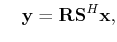
(2) |
 represents the data acquired at
sub-Nyquist rate,
represents the data acquired at
sub-Nyquist rate,
 the densely-sampled
data to be recovered, and
the densely-sampled
data to be recovered, and
 the
restriction operator that selects the acquired samples among the
desired samples. Assume
the
restriction operator that selects the acquired samples among the
desired samples. Assume
 has a sparse representation
 in some transform domain
 where random
sampling creates incoherent noise (e.g. Fourier domain,
where random
sampling creates incoherent noise (e.g. Fourier domain,
 ), then interpolation to a dense grid becomes
a denoising problem in the
domain
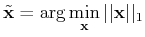
(Donoho et al., 2007). This problem is solved by the following nonlinear
sparsity-promoting optimization
(Hennenfent and Herrmann, 2006; Candes et al., 2005)
), then interpolation to a dense grid becomes
a denoising problem in the
domain
(Donoho et al., 2007). This problem is solved by the following nonlinear
sparsity-promoting optimization
(Hennenfent and Herrmann, 2006; Candes et al., 2005)
 represents an estimated quantity,
and
represents an estimated quantity,
and  the conjugate tranpose. The interpolated result is
given by
the conjugate tranpose. The interpolated result is
given by
 . Note
that, if the sampling at sub-Nyquist rate creates coherent noise in
the
domain (see e.g. Fig. 1(b) when
), the separation between signal and noise
generated by the acquisition in the
domain is much more
delicate (if not impossible) just by imposing a sparsity
constraint. We illustrate this comment by a simple 1-D experiment.
as the discrete cosine transform. We generate a
vector
of length
. Note
that, if the sampling at sub-Nyquist rate creates coherent noise in
the
domain (see e.g. Fig. 1(b) when
), the separation between signal and noise
generated by the acquisition in the
domain is much more
delicate (if not impossible) just by imposing a sparsity
constraint. We illustrate this comment by a simple 1-D experiment.
as the discrete cosine transform. We generate a
vector
of length  containing
  nonzero entries
with random amplitudes, random signs, and random positions and
construct
nonzero entries
with random amplitudes, random signs, and random positions and
construct
 . The observations
 are obtained by down-sampling
either
regularly or randomly by a factor of
are obtained by down-sampling
either
regularly or randomly by a factor of
 . Finally, we
solve Eq. 3 and compare the estimated representation
. Finally, we
solve Eq. 3 and compare the estimated representation
 of
to its true representation
. The reconstruction error is measured as the number of
false detections in the discrete cosine transform domain. The results
presented in Fig. 2 are averaged
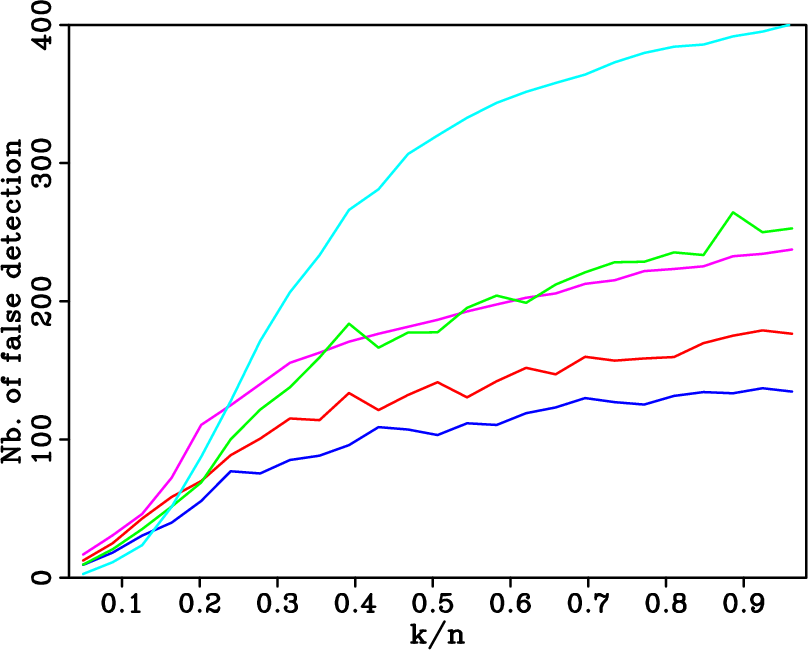
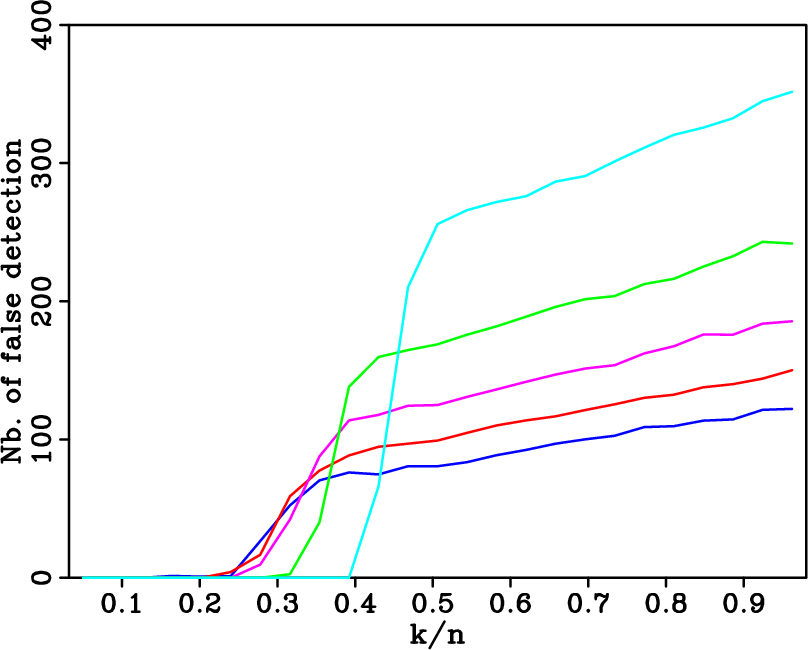
over 50 independent experiments. Figs. 2(a) and
2(b) show the recovery curves for regular and
random downsampling, respectively. Each curve represents the
results obtained for a given subsampling
factor. Fig. 2(a) shows that, regardless of the
subsampling factor and the sparsity of
in the discrete
cosine transform domain, the solution of Eq. 3 is corrupted
by some noise. However, Fig. 2(b) shows that there
is a sparsity zone for each subsampling factor such that the
reconstruction is perfect, i.e. no false detection. The smaller the
subsampling factor, the wider the perfect reconstruction zone.
of
to its true representation
. The reconstruction error is measured as the number of
false detections in the discrete cosine transform domain. The results
presented in Fig. 2 are averaged
over 50 independent experiments. Figs. 2(a) and
2(b) show the recovery curves for regular and
random downsampling, respectively. Each curve represents the
results obtained for a given subsampling
factor. Fig. 2(a) shows that, regardless of the
subsampling factor and the sparsity of
in the discrete
cosine transform domain, the solution of Eq. 3 is corrupted
by some noise. However, Fig. 2(b) shows that there
is a sparsity zone for each subsampling factor such that the
reconstruction is perfect, i.e. no false detection. The smaller the
subsampling factor, the wider the perfect reconstruction zone.
|
|---|
|
phasediagREG,phasediagIRREG
Figure 2. Average recovery curves from sub-Nyquist rate samplings using nonlinear sparsity-promoting optimization. Average recovery curves (a) from regular sub-samplings by
curves and (b) from random sub-samplings by the same factors as in (a)
|
![[scons]](icons/configure.png)
|
|
|
|
|
| Random sampling: new insights into the reconstruction of coarsely-sampled wavefields | |
|
 s.t.
s.t.