


![[pdf]](icons/pdf.png)
|
|
|
|
| Random sampling: new insights into the reconstruction of coarsely-sampled wavefields | |
|
![$ [-B,B]$](img2.png) corresponds to a multiplication with a Dirac comb in
the time domain and thus to a convolution with another Dirac comb in
the frequency domain. As a consequence, the original spectrum becomes
periodic after discretization. Problems occur when regularly sampling
below Nyquist rate, i.e.
corresponds to a multiplication with a Dirac comb in
the time domain and thus to a convolution with another Dirac comb in
the frequency domain. As a consequence, the original spectrum becomes
periodic after discretization. Problems occur when regularly sampling
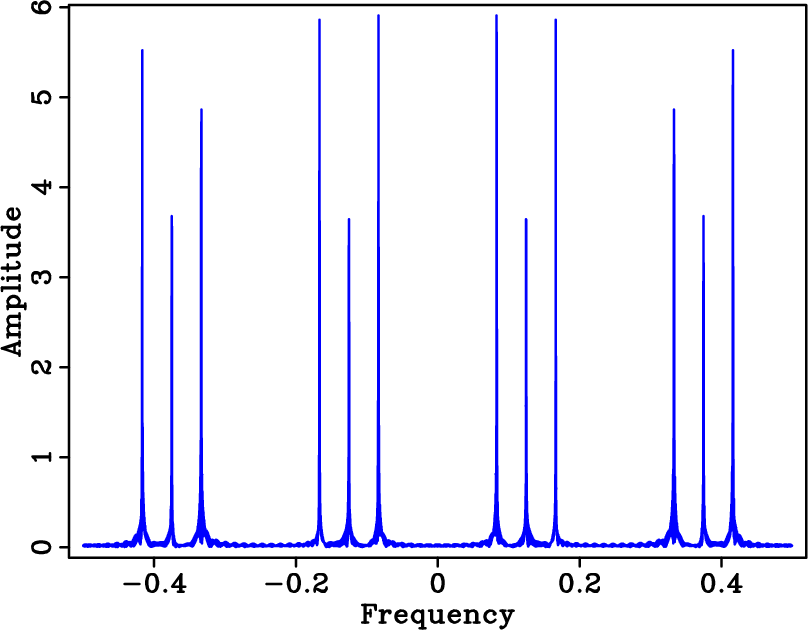
below Nyquist rate, i.e.  . Replicas of the original spectrum
overlap, which creates an indetermination in the reconstruction
process. This is the well-known phenomenon of aliasing. In contrast,
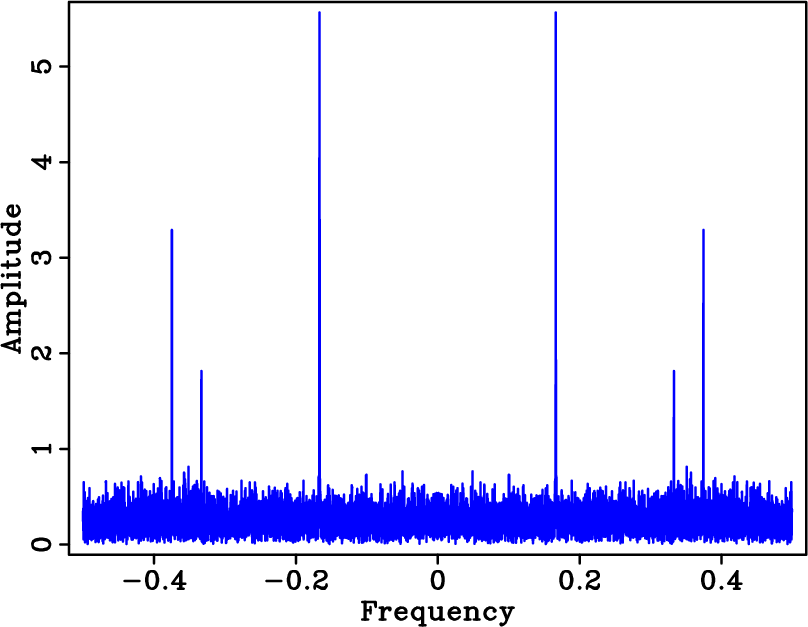
random sampling at the same sub-Nyquist rate is less likely to create
strong aliases but rather weak broadband noise. Consider for example a
random sampling operator
. Replicas of the original spectrum
overlap, which creates an indetermination in the reconstruction
process. This is the well-known phenomenon of aliasing. In contrast,
random sampling at the same sub-Nyquist rate is less likely to create
strong aliases but rather weak broadband noise. Consider for example a
random sampling operator
 over
over
![$ \left[0,N\right]$](img5.png) where
where
 is the size of the sampling region. Suppose that
samples
is the size of the sampling region. Suppose that
samples  points uniformly distributed in the interval. Then, the
expectation of the power spectrum of
over
is given by
(Dippe and Wold, 1985; Leneman, 1966)
points uniformly distributed in the interval. Then, the
expectation of the power spectrum of
over
is given by
(Dippe and Wold, 1985; Leneman, 1966)
 denotes Fourier coefficients,
E
denotes Fourier coefficients,
E![$ \left[\cdot\right]$](img10.png) the mathematical expectation, and
the mathematical expectation, and  is
the frequency variable. The first term in this expression is only
nonzero at the origin and gives through convolution a scaled version
of the original spectrum. The second term is only zero at the origin
and can be assimilated to broadband noise.
is
the frequency variable. The first term in this expression is only
nonzero at the origin and gives through convolution a scaled version
of the original spectrum. The second term is only zero at the origin
and can be assimilated to broadband noise.
|
|---|
|
spec,specREG,specIRREG
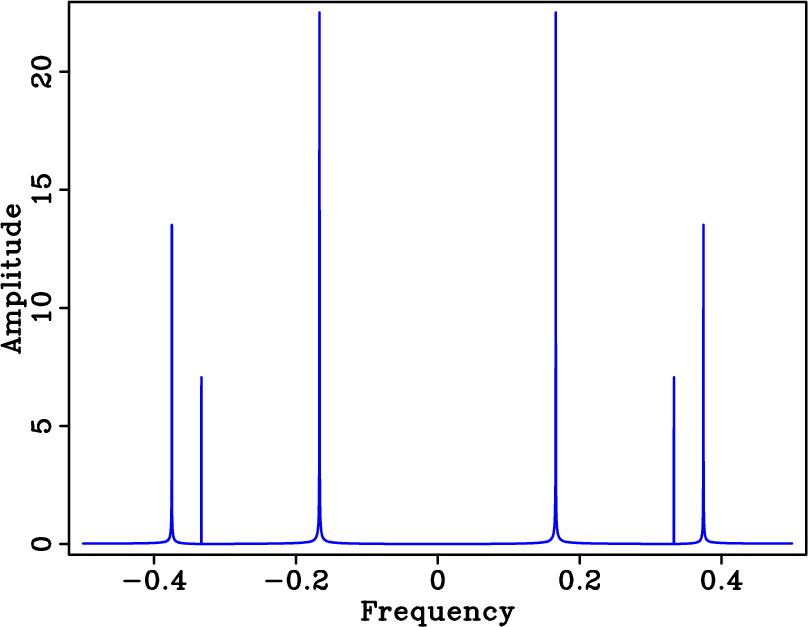
Figure 1. Spectra of a signal sampled above and below Nyquist rate. The signal consists of the superposition of three cosine functions. Amplitude spectrum of the densely-sampled signal (a), coarse regularly-sampled signal (b), and coarse randomly-sampled signal (c). |
![[scons]](icons/configure.png)
|
|
|
|
|
| Random sampling: new insights into the reconstruction of coarsely-sampled wavefields | |
|
![$\displaystyle \left[\vert\hat{\mathbf{s}}_N(u)\vert^2\right] = n^2\delta_{u0} + \left(1-\delta_{u0}\right)n,$](img8.png)