Improving reservoir state estimation in Digital Twins Using Angle-Gather Conditioning and Rock-Physics Context
Digital Twins for subsurface monitoring use simulation-based inference to map seismic and well-log observations to evolving reservoir states such as CO2 saturation and pressure. When the simulation forward models rely on simplified or misspecified rock physics, predictions become biased and uncertainty quantification degrades. We address this by combining rock-physics-aware amortized Bayesian inference with inference in the Radon domain of common-image gathers (CIGs). Angle-dependent information from Radon-transformed subsurface offset gathers improves separation of fluid and stress effects: fluids exhibit distinct amplitude-variation-with-angle (AVA) signatures, so conditioning the digital twin on angle gathers yields more accurate and physically consistent joint estimates of saturation and pressure than conditioning on migrated stacks or offset-domain gathers. We train a context-aware amortized posterior estimator that conditions on seismic data and rock-physics context, enabling robustness to model misspecification and structured what-if analysis at inference time without retraining. On a synthetic 2D geological carbon storage scenario, conditioning on Radon-transformed CIGs improves joint saturation and pressure prediction relative to reverse-time migrated images, while context conditioning preserves interpretability and calibration under rock physics uncertainty.
\[ \def\textsc#1{\dosc#1\csod} \def\dosc#1#2\csod{{\rm #1{\small #2}}} \]
INTRODUCTION
Reliable monitoring of subsurface reservoirs, ranging from geological carbon storage (GCS) and enhanced oil recovery (EOR) to conventional hydrocarbon production, requires accurate estimation of evolving reservoir states (e.g., saturation and pressure) from time-lapse geophysical observations to ensure containment and conformance (Ringrose 2020, 2023). Digital Twins (DT) address this by learning amortized prior-to-posterior mappings from simulated state–observation ensembles, enabling uncertainty-aware forecasting without iterative inversion at inference time (Gahlot et al. 2025; Herrmann 2023).
However, the accuracy of DTs depends strongly on the forward modeling assumptions, particularly the rock-physics models that map reservoir states (e.g., CO2 saturation and pressure) to seismic properties. In earlier work, we showed that misspecification of this mapping leads to biased state estimates and miscalibrated uncertainty: when the training and observed data are governed by different rock physics, the resulting out-of-distribution (OOD) mismatch produces systematic errors in plume estimation (Gahlot and Herrmann 2025; Gahlot, Erdinc, and Herrmann 2025).
Including pressure-dependent rock physics further complicates inference because pressure alters the seismic response, creating ambiguity between pressure and saturation effects in the observed data (Landrø 2001). The combined influence of saturation and pressure is inherently non-linear. At lower to moderate pressures, increasing pressure can enhance sensitivity to saturation changes through frame stiffening, whereas at higher pressures this sensitivity diminishes as the rock frame becomes stiffer and fluid property contrasts are reduced (Mavko, Mukerji, and Dvorkin 2009; Batzle and Wang 1992). This ambiguity becomes particularly problematic under rock-physics misspecification, where the model cannot uniquely attribute observed seismic variations to either pressure or saturation. As illustrated in figure 2 (compared to the ground truth in figure 1), this leads to degraded state estimates when pressure effects are included in the observation model. Under such misspecification, both the prediction error (RMSE; figure 3) and posterior uncertainty (pixel-wise standard deviation; figure 4) increase markedly. This indicates a biased posterior that misattributes pressure-induced seismic variations to saturation changes. Different combinations of pressure and saturation can produce similar seismic responses, broadening the posterior and reducing identifiability of the true reservoir state.
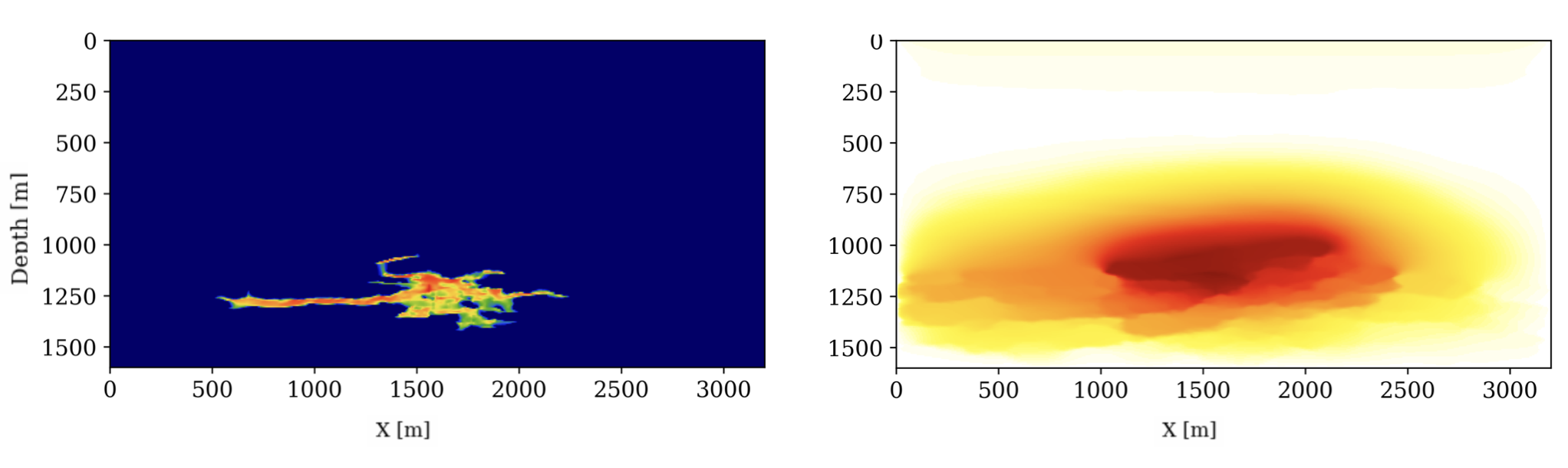
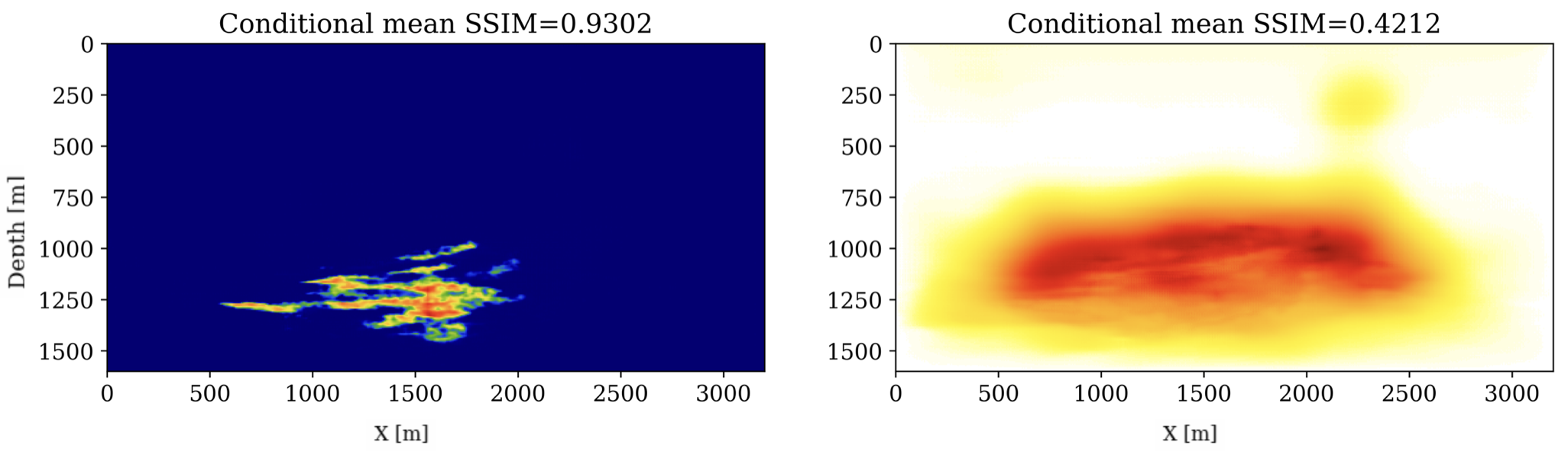
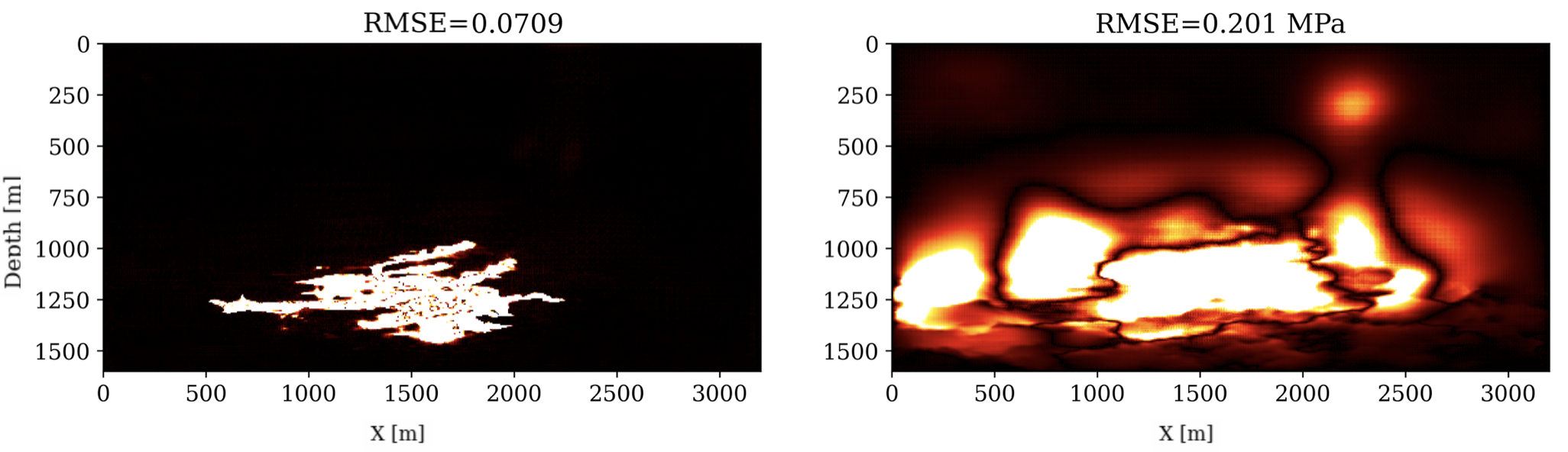
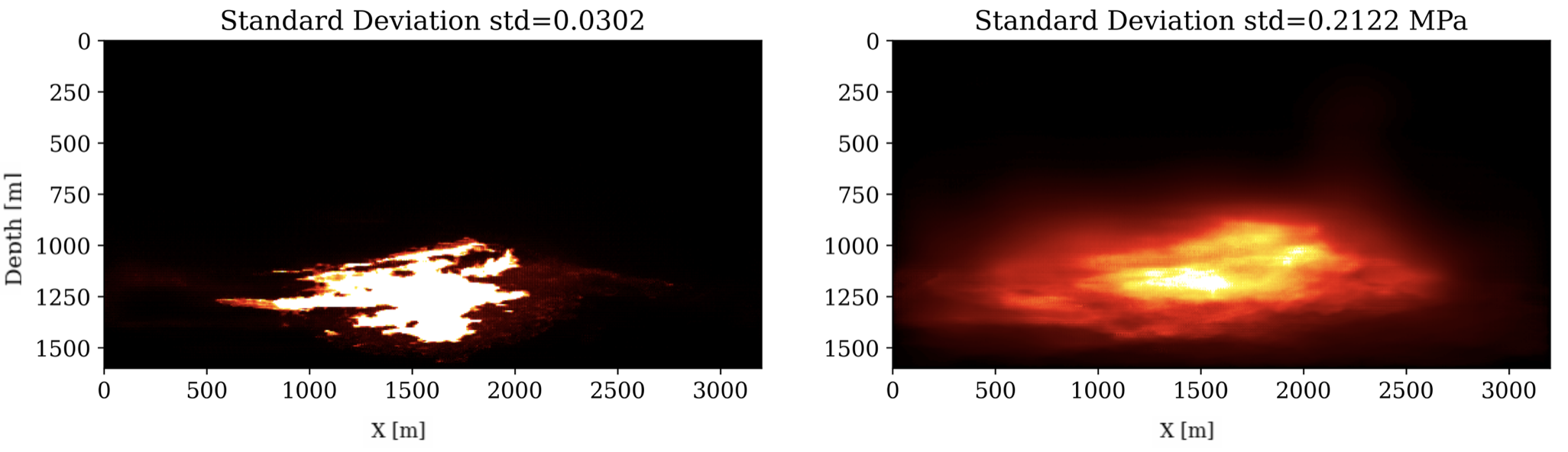
Two main factors contribute to this degradation in performance under rock-physics misspecification. First, standard DT training typically assumes a single rock-physics model and therefore cannot explicitly disentangle uncertainty in reservoir properties from uncertainty in the underlying rock physics. As a result, errors due to incorrect rock physics can be incorrectly attributed to changes in the reservoir state. Second, conventional seismic representations—reverse-time migrated (RTM) images (Baysal, Kosloff, and Sherwood 1983)—collapse angle-dependent reflectivity into stacked images, thereby losing information contained in amplitude variation with angle (AVA). This loss limits the ability to distinguish between fluid-induced and pressure-induced changes, since these mechanisms can produce similar responses in stacked data but differ in their angle-dependent behavior. Together, these factors can produce biased posteriors when the underlying rock physics or stress conditions deviate from the training assumptions (Gahlot and Herrmann 2025).
Building on sensitivity-aware amortized Bayesian inference (Elsemüller et al. 2024) and our rock-physics-augmented DS framework (Gahlot and Herrmann 2025), we propose a sensitivity-aware digital twin that (i) treats pressure-dependent rock physics as an explicit context variable during training, enabling amortized what-if analysis over rock-physics assumptions without retraining, and (ii) conditions on Radon-transformed angle gathers (Kumar, Leeuwen, and Herrmann 2013) derived from subsurface-offset common-image gathers (CIGs) (Sava and Vasconcelos 2011; Yin et al. 2024). By combining augmentation over rock physics with angle-domain conditioning, the proposed approach leverages angle-dependent AVA information to better separate pressure and saturation effects and remains robust when pressure-dependent rock physics is present.
On a synthetic 2D subsurface storage scenario with uncertain permeability and pressure-dependent Brie-type rock physics, we compare DT performance when conditioning on RTM images and on Radon-transformed angle gathers, and quantify joint saturation–pressure accuracy (SSIM), pressure error, and uncertainty to assess the benefit of the proposed design.
METHODOLOGY
We adopt the sequential Bayesian monitoring setup of our uncertainty-aware digital shadow (Gahlot et al. 2025). The reservoir state \(\mathbf{x}_k\) (CO2 saturation and pressure perturbations) at time step \(k\) evolves according to multiphase flow under uncertain permeability \(\boldsymbol{\kappa}\):
\[ \mathbf{x}_k = \mathcal{M}_k(\mathbf{x}_{k-1}, \boldsymbol{\kappa}), \qquad \boldsymbol{\kappa} \sim p(\boldsymbol{\kappa}). \tag{1}\]
Observations \(\mathbf{y}_k\) are linked to \(\mathbf{x}_k\) via a seismic observation operator that depends on a set of \(\boldsymbol{\eta}\) and noise \(\boldsymbol{\epsilon}_k\). The set of rock physics parameters here is the Brie saturation exponent (Avseth, Mukerji, and Mavko 2010), pressure sensitivity parameters and characteristic pressure from (MacBeth 2004).
\[ \mathbf{y}_k = \mathcal{H}_k(\mathbf{x}_k; \boldsymbol{\eta}, \boldsymbol{\epsilon}_k). \tag{2}\]
We approximate the posterior distribution of the reservoir state \(\mathbf{x}_k\) given observations \(\mathbf{y}_{1:k}\) and rock-physics parameters \(\boldsymbol{\eta}\) using a neural network \(q_{\boldsymbol{\phi}}(\mathbf{x}_k \mid \mathbf{y}_{1:k}, \boldsymbol{\eta})\), implemented using a conditional normalizing flow (CNF) (Papamakarios et al. 2021; Gahlot et al. 2025). In contrast to standard formulations, we extend the normalizing flow to explicitly incorporate rock-physics parameters as conditioning variables. The model is trained on simulated triples consisting of reservoir states (CO2 saturation and pressure), corresponding seismic observations, and associated rock-physics parameters. During training, the network learns a mapping from observations and rock-physics parameters to the posterior distribution over reservoir states. Conditioning on \(\boldsymbol{\eta}\) follows sensitivity-aware amortized Bayesian inference (Elsemüller et al. 2024), where a single network is trained across multiple rock-physics configurations. The rock-physics parameters are encoded (e.g., using Fourier features (Tancik et al. 2020)) and injected into the network via feature-wise linear modulation (FiLM), enabling the model to represent a family of posteriors conditioned on different rock-physics assumptions. This weight-sharing across contexts is effective when the underlying mapping from observations to reservoir states varies smoothly with respect to \(\boldsymbol{\eta}\) and when the distribution of reservoir states remains similar across rock-physics configurations. Under these conditions, a single network can generalize across contexts while retaining sensitivity to changes in rock physics.
Seismic data representation. The conditioning input \(\mathbf{y}_k\) can be chosen as RTM images or angle gathers. To construct angle gathers, we first compute subsurface offset common-image gathers (CIGs) using two-way wave-equation extended imaging (Sava and Vasconcelos 2011). These CIGs are then transformed to the angle domain via a Radon transform that maps subsurface offset to reflection angle (or horizontal slowness \(p = \sin\alpha/v\)), enabling amplitude-variation-with-angle (AVA) analysis (Kumar, Leeuwen, and Herrmann 2013). This representation preserves angle-dependent reflectivity, which is largely collapsed in migrated (RTM) images. As a result, angle gathers retain information that helps distinguish between different physical mechanisms affecting the seismic response. In particular, pressure and saturation changes can produce similar signatures in stacked images but differ in their angle-dependent behavior. By conditioning the digital twin on angle gathers, the model has access to this additional information, improving its ability to separate pressure and saturation effects during inference.
Training follows the usual DT workflow: an ensemble of states is forecast with the flow simulator under \(p(\boldsymbol{\kappa})\); for each state, synthetic seismic data are generated for multiple samples of rock physics parameters \(\boldsymbol{\eta} = (e, E_k, P_c) \sim p(\boldsymbol{\eta})\) (e.g., \(e \sim \mathcal{U}(1,10)\) for the Brie exponent (Avseth, Mukerji, and Mavko 2010), \(E_k \sim \mathcal{U}(0.5,4)\) for pressure sensitivity, and \(P_c \sim \mathcal{U}(5\,\text{MPa},15\,\text{MPa})\) for the characteristic pressure (MacBeth 2004)). The CNF is trained to maximize the log-density of the state given the observation and context, yielding \[ \widehat{\boldsymbol{\phi}} = \mathop{\mathrm{argmin}\,}\limits_{\boldsymbol{\phi}} \frac{1}{M}\sum_{m=1}^M \bigl( \frac{1}{2}\|f_{\boldsymbol{\phi}}(\mathbf{x}^{(m)}; (\mathbf{y}^{(m)}, C^{(m)}))\|_2^2 - \log|\det \mathbf{J}^{(m)}_{f_{\boldsymbol{\phi}}}|\bigr), \] where \(C^{(m)}\) encodes \(\boldsymbol{\eta}^{(m)}\). At inference, posterior samples are drawn by inverting the flow conditioned on observed \(\mathbf{y}_k^{\mathrm{obs}}\) and a chosen \(\boldsymbol{\eta}\).
SYNTHETIC CASE STUDY
We use a 2D synthetic model derived from the Compass model (E. Jones et al. 2012), discretized on a \(512 \times 256\) grid at \(6.25\,\mathrm{m}\) resolution. Permeability ensembles are derived from a probabilistic baseline velocity model obtained with the WISE framework (Yin et al. 2024); flow simulations are performed with JutulDarcy.jl (Møyner, Bruer, and Yin 2023) with supercritical CO2 injected at \(0.05\,\mathrm{m^3/s}\) for 1920 days. We consider four time-lapse intervals. For each forecast state, we generate synthetic seismic data using multiple rock-physics models. Nonlinear wave modeling and imaging are performed using JUDI.jl (Witte et al. 2019; Louboutin et al. 2023). Subsurface offset CIGs are computed using ImageGather.jl (Louboutin 2021), and angle gathers are obtained via a Radon transform using SeismicAngleGathers.jl (Gahlot 2024). The conditioning input to the CNF is either (a) RTM images or (b) Radon-transformed angle gathers. Colored Gaussian noise (28 dB SNR) is added to shot records before the extended imaging. The CNF is implemented with InvertibleNetworks.jl (Orozco et al. 2024), with context \(C\) for the rock physics \(\eta\) integrated via Fourier features and FiLM in the conditioning branch.
RESULTS
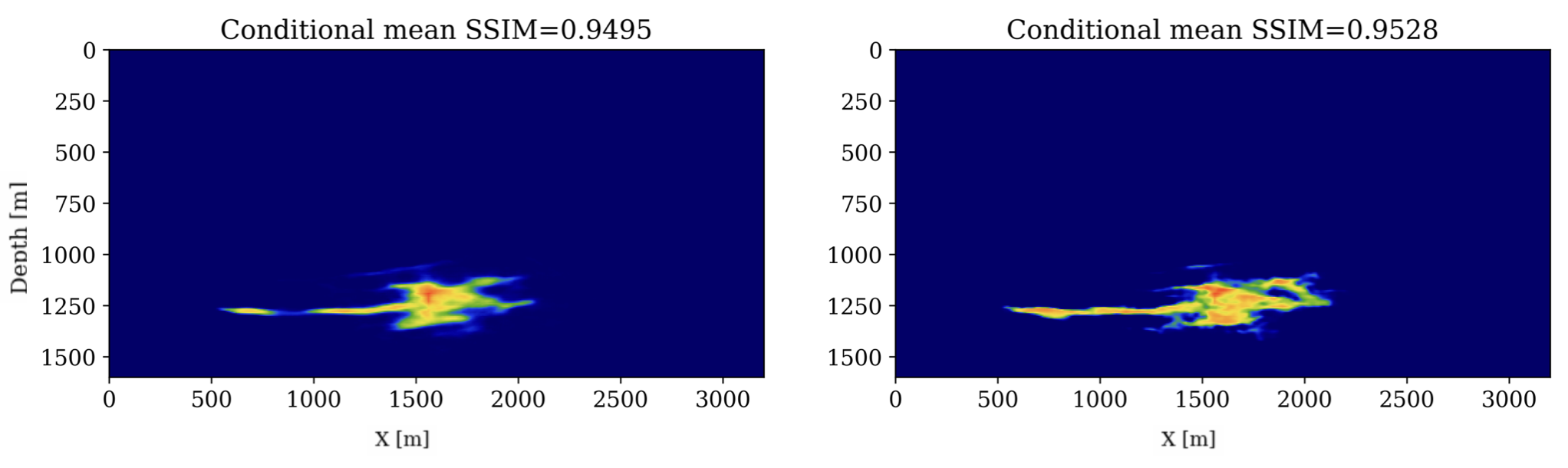
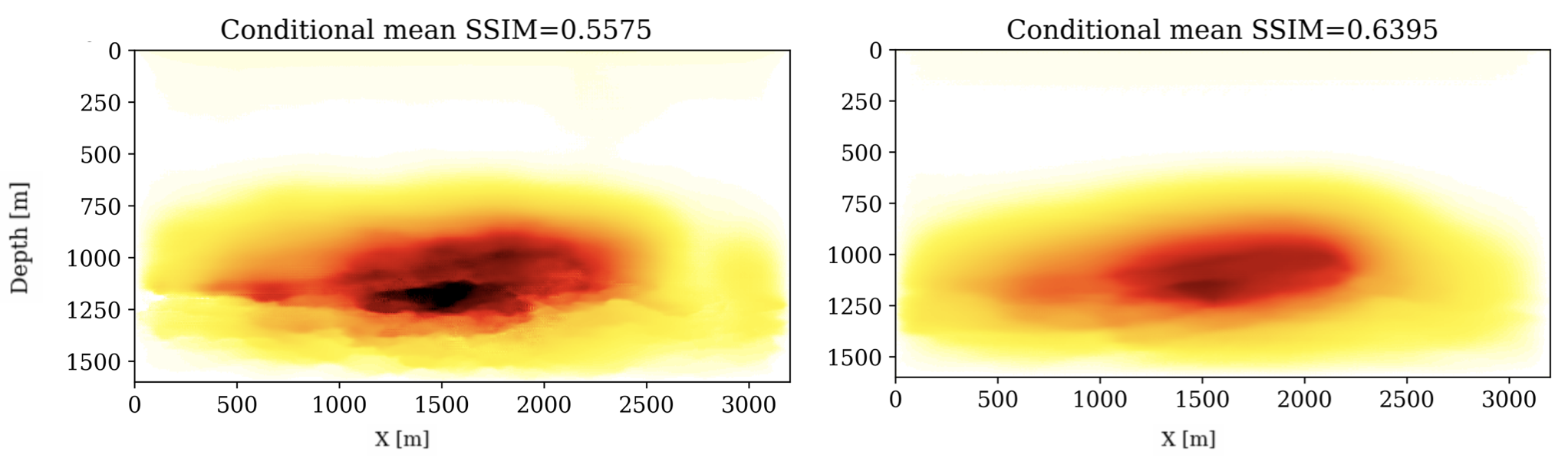
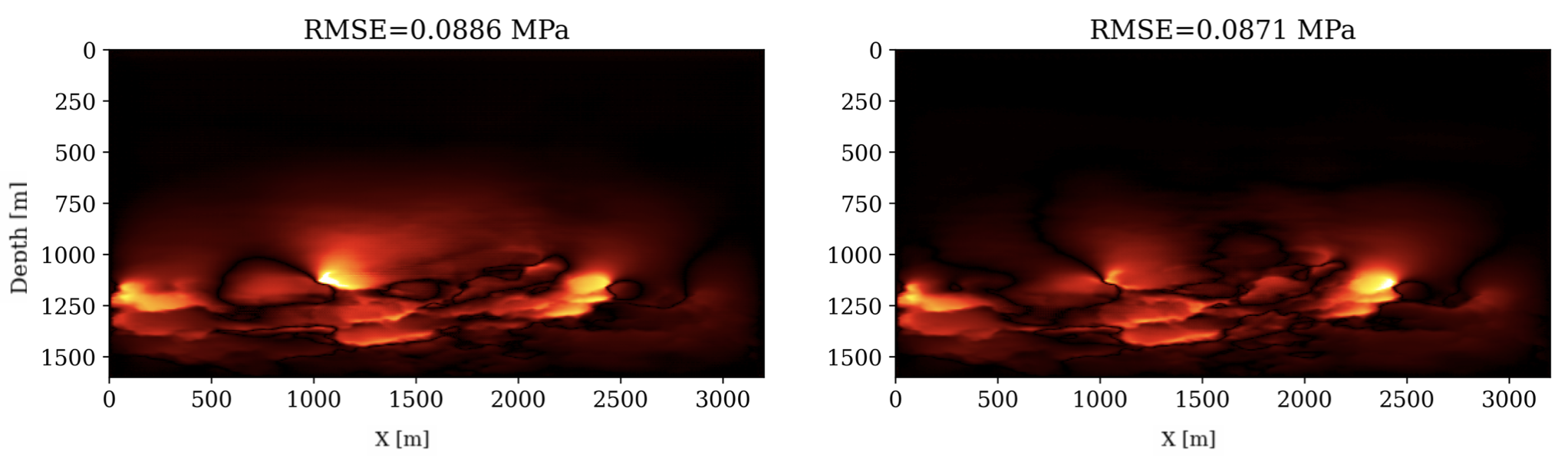
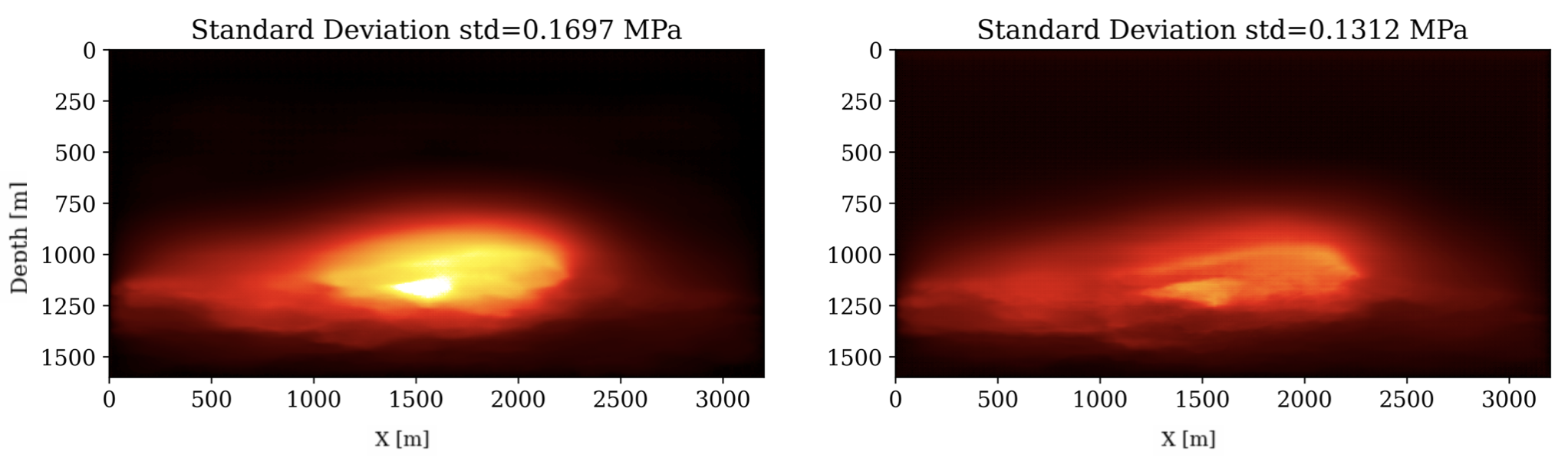
We evaluate posterior accuracy for CO2 saturation and pressure under two conditioning inputs: RTM images (left) and Radon-transformed angle gathers (right). As shown in figure 5, angle-gather conditioning improves saturation estimates, producing plume geometries closer to the ground truth and increasing SSIM from 0.9495 to 0.9528. For pressure (figure 6), the improvement is more pronounced, with SSIM increasing from 0.5575 to 0.6395. This is consistent with the RMSE reduction in figure 7 (from 0.0886 MPa to 0.0871 MPa). Posterior uncertainty is also reduced under angle-gather conditioning (figure 8), with pixel-wise standard deviation decreasing from 0.1697 MPa to 0.1312 MPa, indicating improved accuracy and calibration. Together, these results demonstrate that angle-domain conditioning leads to more reliable joint estimation of saturation and pressure.
CONCLUSIONS
We combine context-aware amortized Bayesian inference with conditioning on Radon-transformed common-image gathers to improve reservoir state prediction in digital twins for geological carbon storage monitoring. In synthetic experiments, conditioning on angle gathers improves both CO2 saturation and pressure estimates relative to RTM conditioning: pressure error (RMSE) decreases and posterior uncertainty is reduced, indicating better-calibrated predictions. Saturation estimates are also closer to the ground truth under angle-gather conditioning. By treating rock physics as an explicit context variable, the proposed approach retains robustness to pressure-dependent rock-physics misspecification and enables structured what-if analysis at inference time without retraining. Overall, this provides a practical path toward more accurate and uncertainty-aware digital twins under rock-physics uncertainty.
Acknowledgement
This research was carried out with the support of Georgia Research Alliance, partners of the ML4Seismic Center, and in part by the US National Science Foundation grant OAC 2203821. ChatGPT was used to improve readability and sentence structure. The authors reviewed all content and take full responsibility for the manuscript.