Learned Multiphysics Inversion with Differentiable Programming & Machine Learning

An open-source path from wave physics to CO₂ digital twins

Mathias Louboutin, Ipsita Bhar, Huseyin Tuna Erdinc and Felix J. Herrmann

Devito Codes and Georgia Institute of Technology — ML4Seismic/SLIM group

2026-06-07

Donoho’s frictionless-reproducibility triad

After (Donoho, 2024), a field crosses the reproducibility singularity only once all three become frictionless open services:

[FR-1]Data

Public, citable, one-click research data.

[FR-2]Code

Code sharing with exact re-execution by anyone.

[FR-3]Challenges

Shared dataset, quantified metric, public leaderboard.

Empirical ML has all three. Geophysics so far has mostly [FR-2] — strong open software, but data and challenges still missing.

End-to-end multiphysics — every arrow differentiable
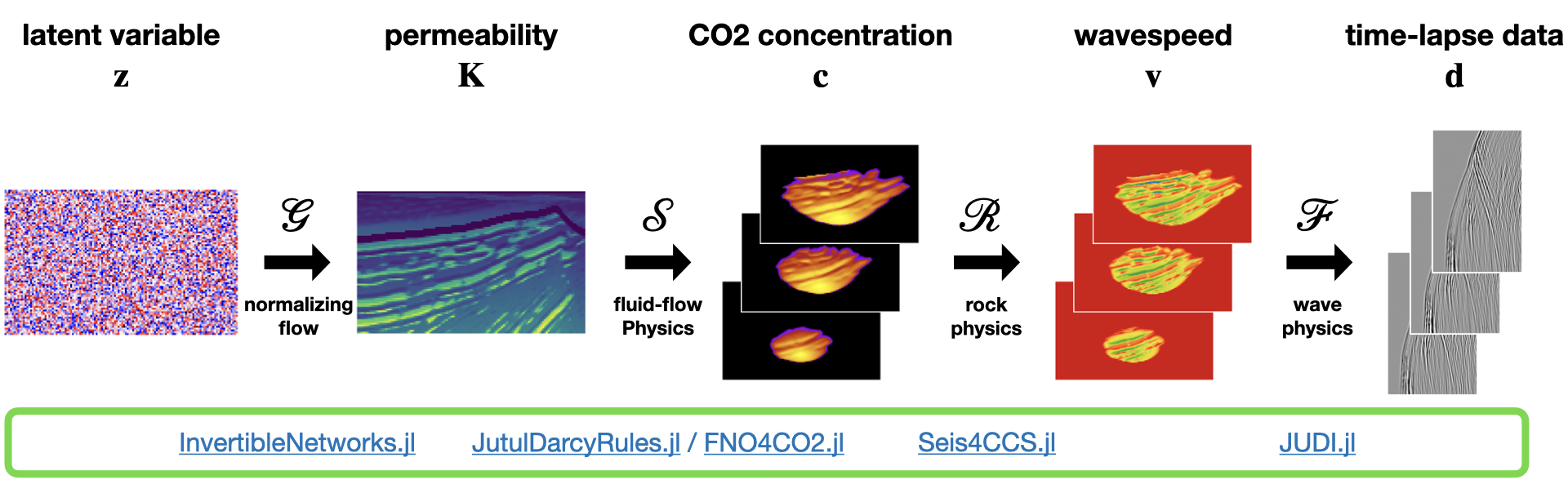
\[\mathbf{z} \xrightarrow{\;\mathcal{G}\;} \mathbf{K} \xrightarrow{\;\mathcal{S}\;} \mathbf{c} \xrightarrow{\;\mathcal{R}\;} \mathbf{m} \xrightarrow{\;\mathcal{F}(\cdot)\mathbf{q}\;} \mathbf{d}\]

Generative NF · multiphase flow · rock physics · wave physics — one AD graph, one gradient (Louboutin, Yin, et al., 2023; Yin et al., 2023).

A differentiable open-source stack

Wave physics

Reservoir physics

ML / surrogates

AD glue

Register the adjoint once — compose freely across PDEs, ML, and surrogates (Innes et al., 2019).

ML-prior FWI — composing AD across physics & networks

\[\min_{\mathbf{z}}\ \tfrac{1}{2}\|\mathcal{F}(\mathcal{G}_{\theta^\ast}(\mathbf{z}))\mathbf{q} - \mathbf{d}\|_2^2 + \tfrac{\lambda}{2}\|\mathbf{z}\|_2^2\]

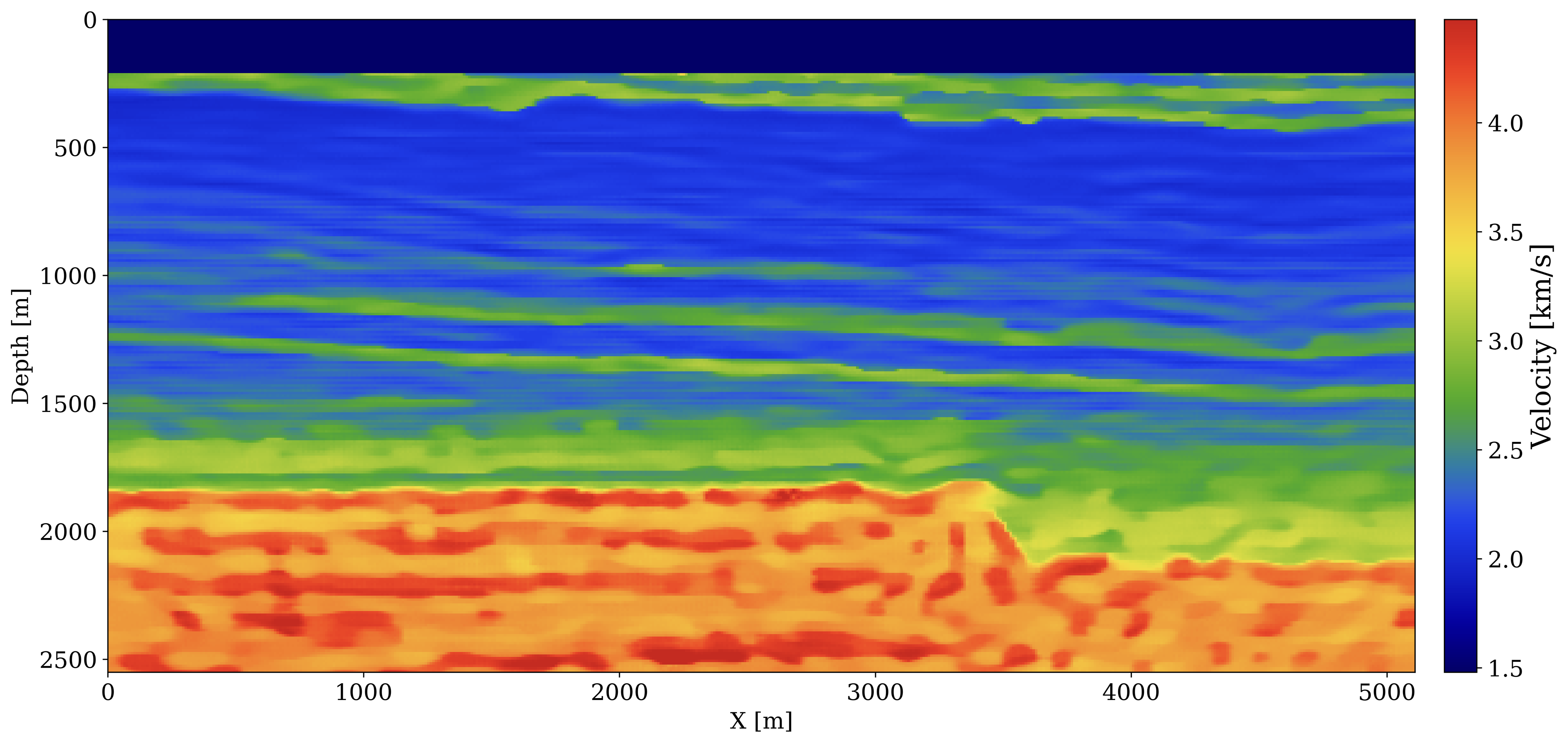
NF prior \(\mathcal{G}_{\theta^\ast}\) trained on Compass slices; gradient flows through wave physics and through the invertible net.

Truth
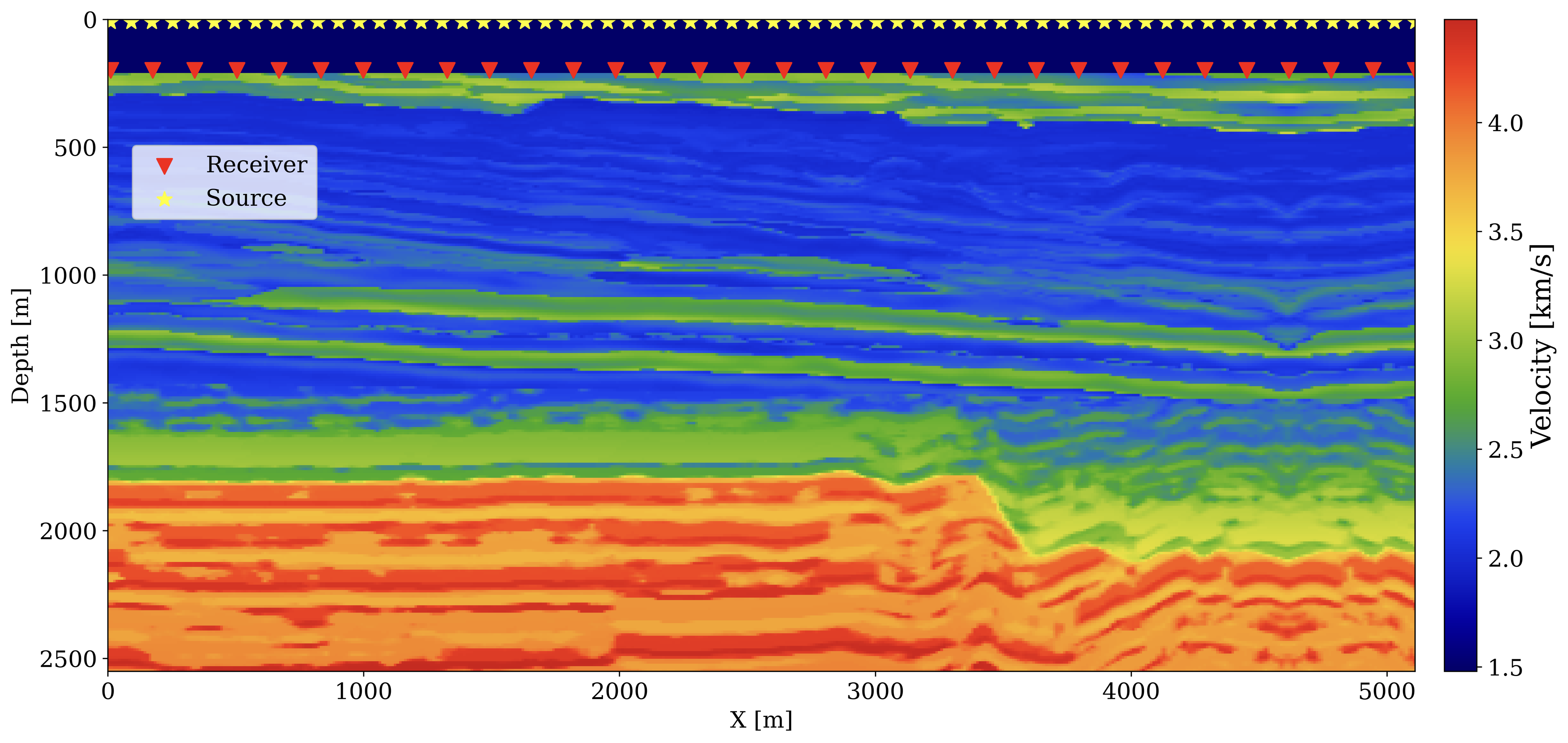
Vanilla
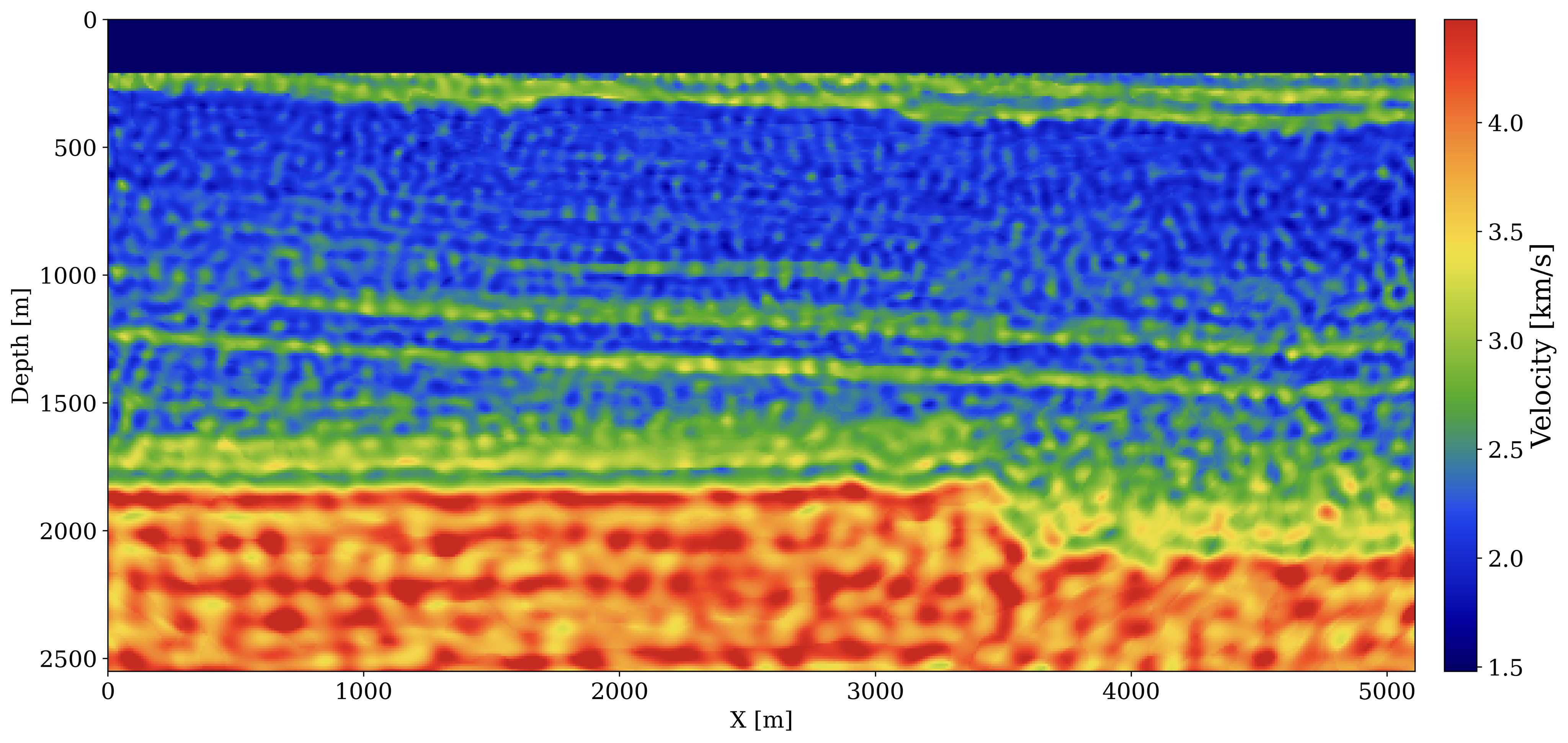
+ NF prior
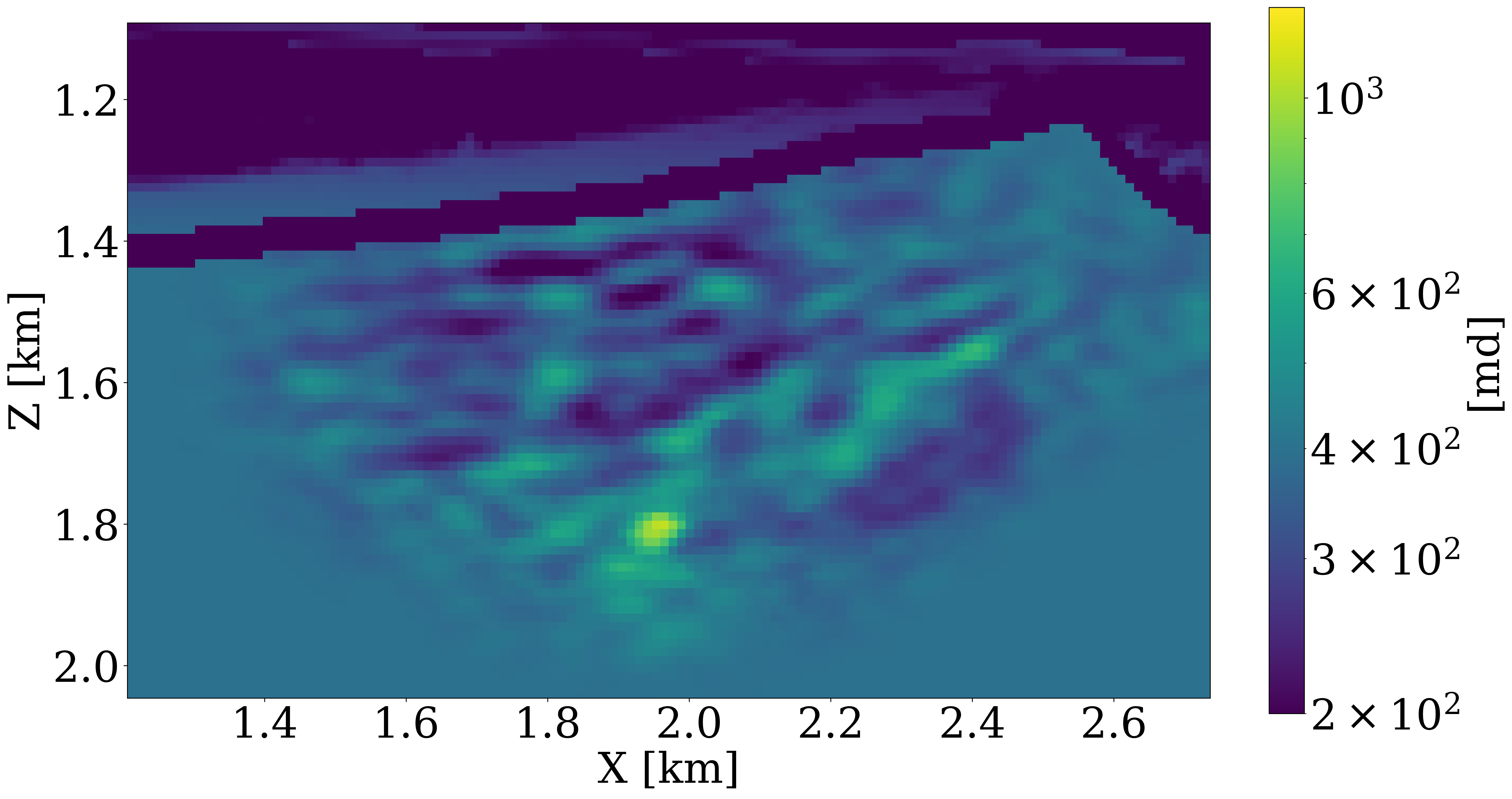
End-to-end permeability inversion from time-lapse seismic
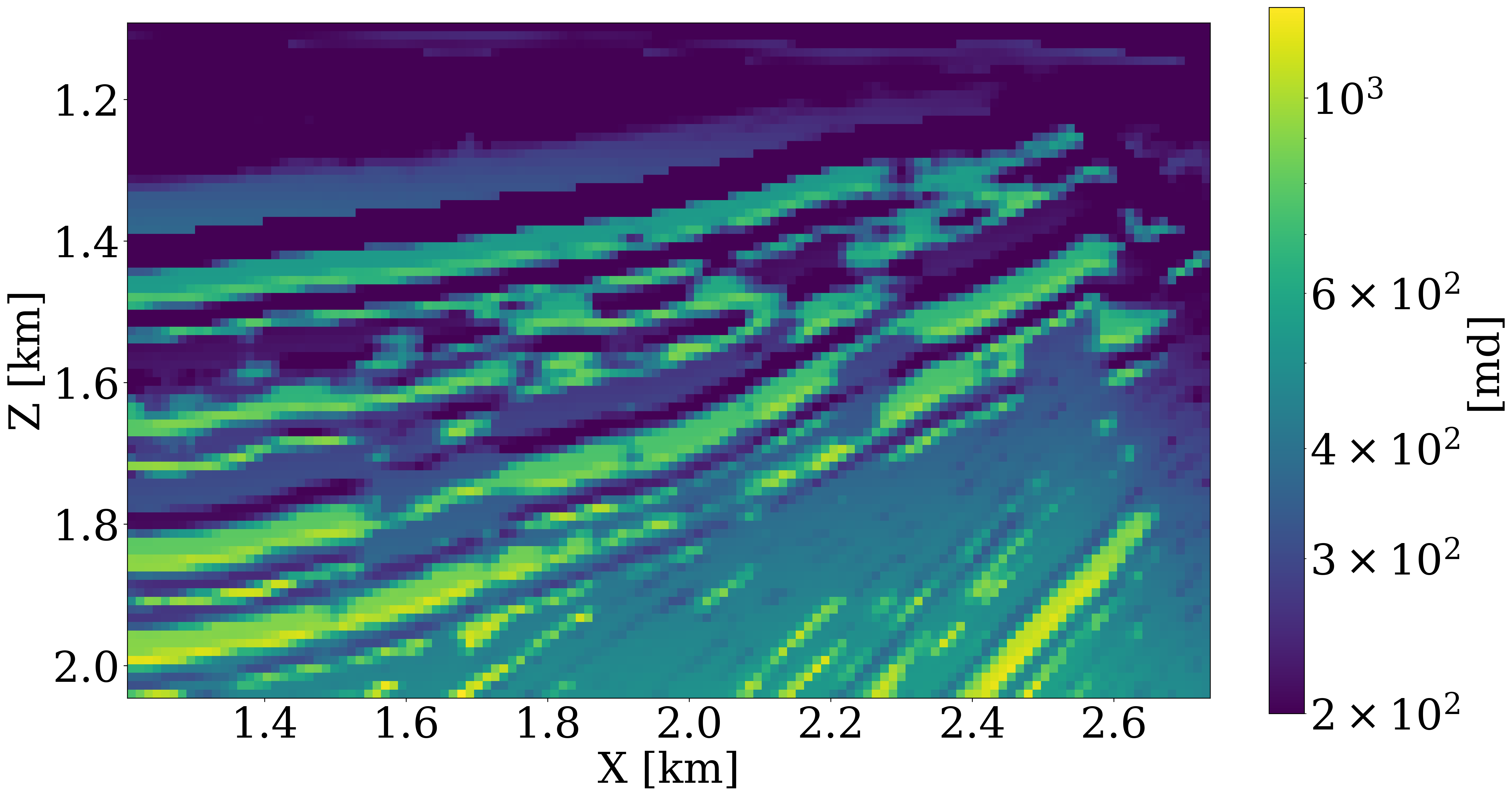
True log-permeability

Inverted with FNO surrogate

One AD graph: wave physics → rock physics → multiphase flow (or FNO surrogate) → NF latent prior. No glue code, no manual adjoints (Grady II et al., 2023; Louboutin, Yin, et al., 2023).

Best in class — but lacks training data

Independent comparison of differentiable subsurface-flow / inversion frameworks ranks SLIM’s stack best in class on capability — and flags the same gap we feel internally:

“Lacks training data.”

We have the physics, the AD, the networks, the workflows. What we don’t have are curated, ML-ready Earth and reservoir datasets to train priors and surrogates at industry scale.

Closing the [FR-1] gap with SAGE

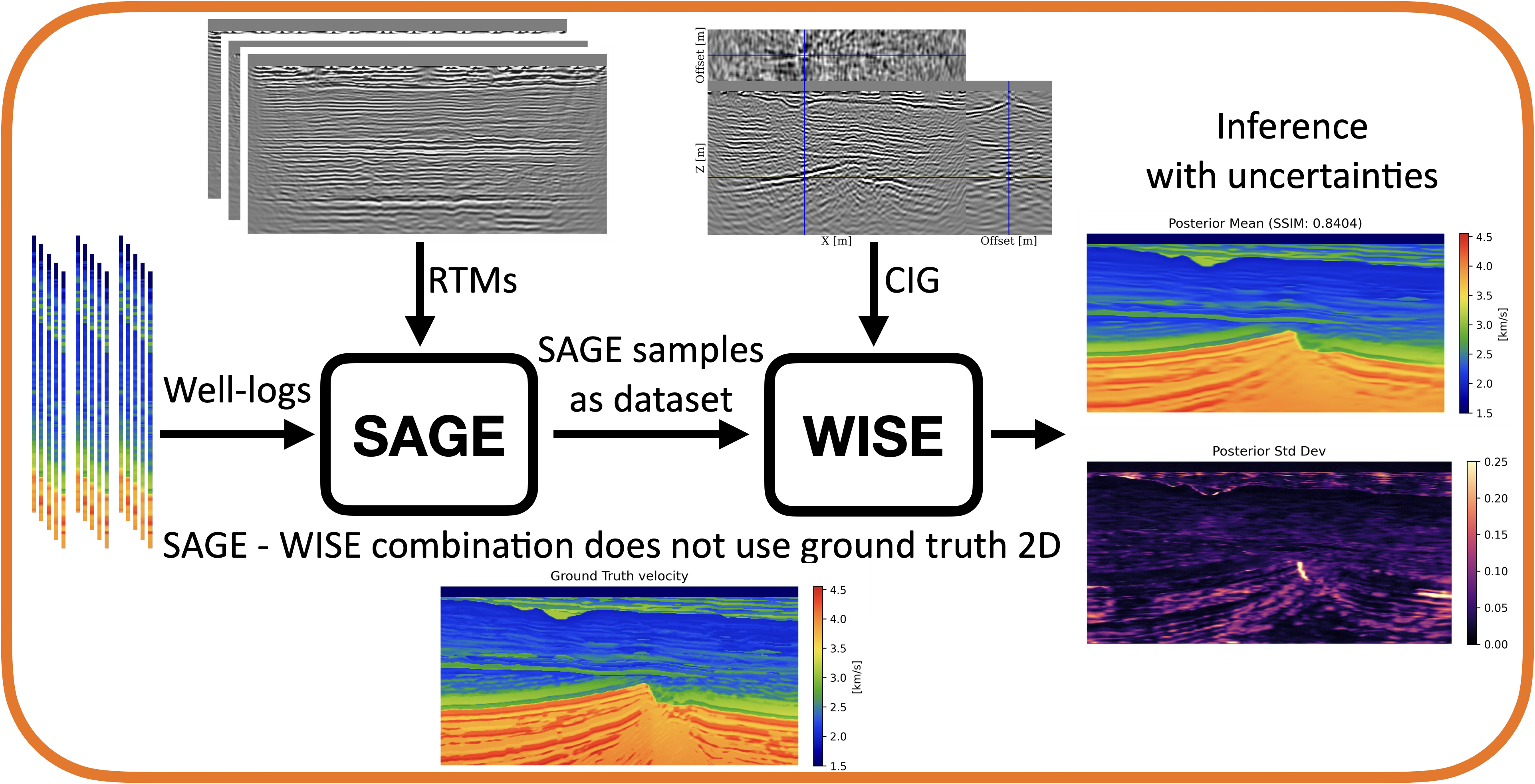
SAGESubsurface AI-driven Geostatistical Extraction of proxy posteriors (Erdinc et al., 2026) — distills National Data Repository information into a trainable prior, plugged into WISE [variational FWI; Yin et al. (2024b); Yin et al. (2024a)] via WISE.jl.

[FR-1] data — UK National Data Repository curation
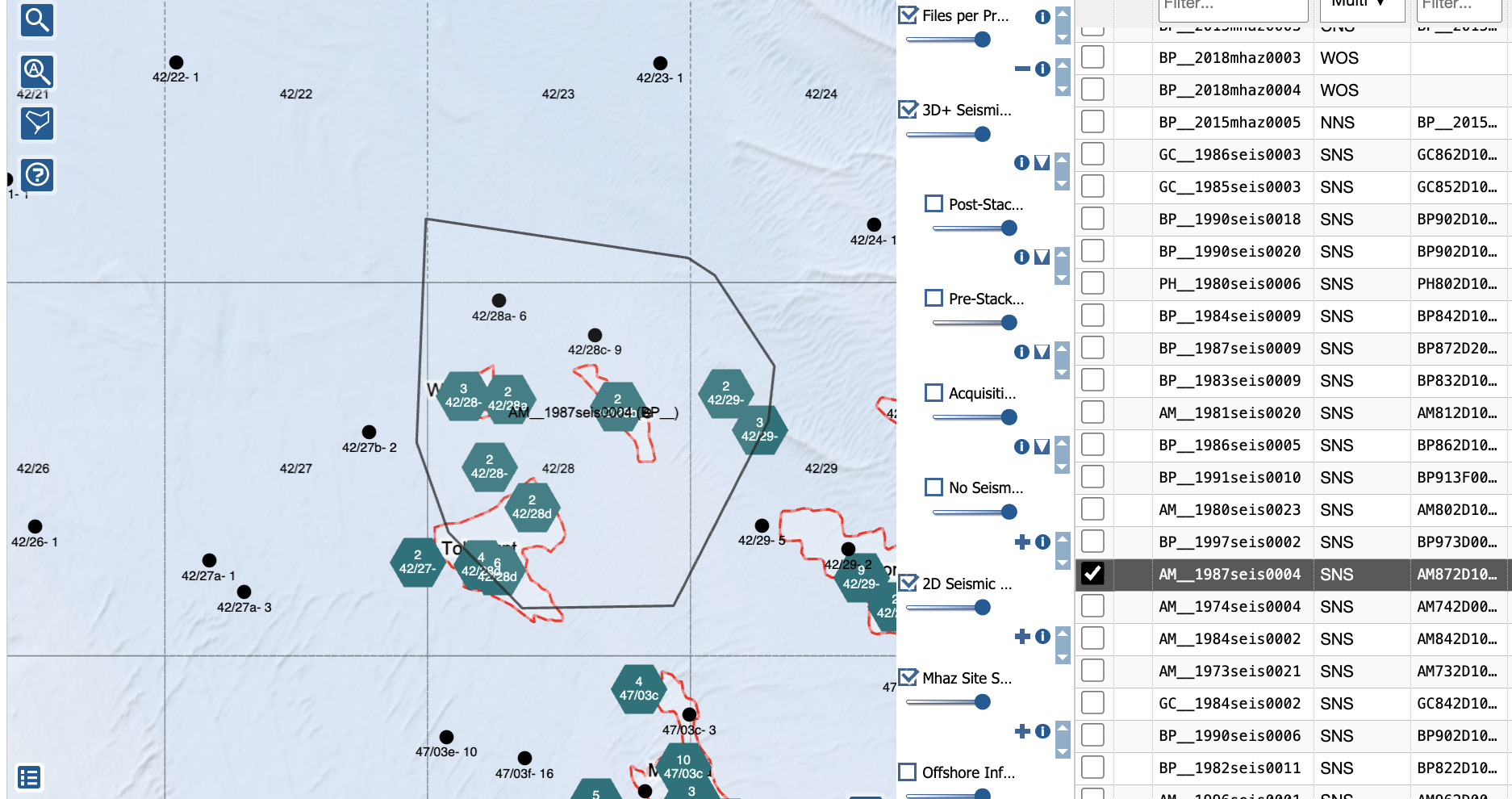
OpenSeisML (Bhar et al., 2026): automated pipeline curating imaged seismic + well logs from the UK NDR into a reproducible, ML-ready dataset for generative priors.

  • time → depth via checkshots
  • post-stack volumes + petrophysical logs
  • North Sea geology, multiple surveys
  • reproducible, open, at scale

Proxy prior — sampling plausible velocity realizations
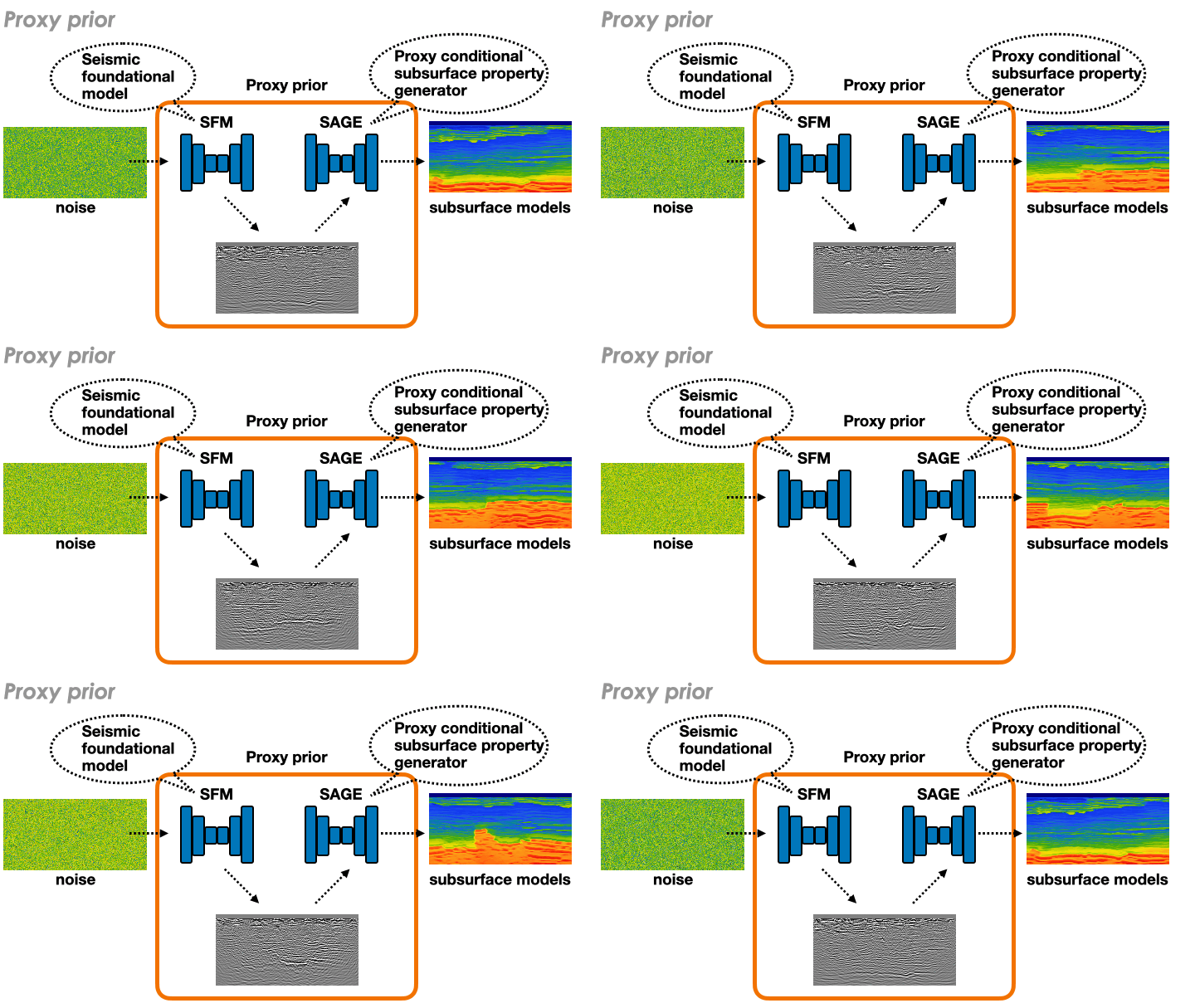
Two-network distillation (Erdinc et al., 2026):

  1. Generative net on 3D imaged seismic → image realizations.
  2. Conditional 2D net on image ↔︎ well pairs → velocity / property realizations.

Result: a learned proxy prior \(p(\mathbf{m})\) used to train WISE / end-to-end inversion.

Currated training pairs from UK-NDR

Currated training samples (Bhar et al., 2026; Erdinc et al., 2026).

Guided inference with SAGE
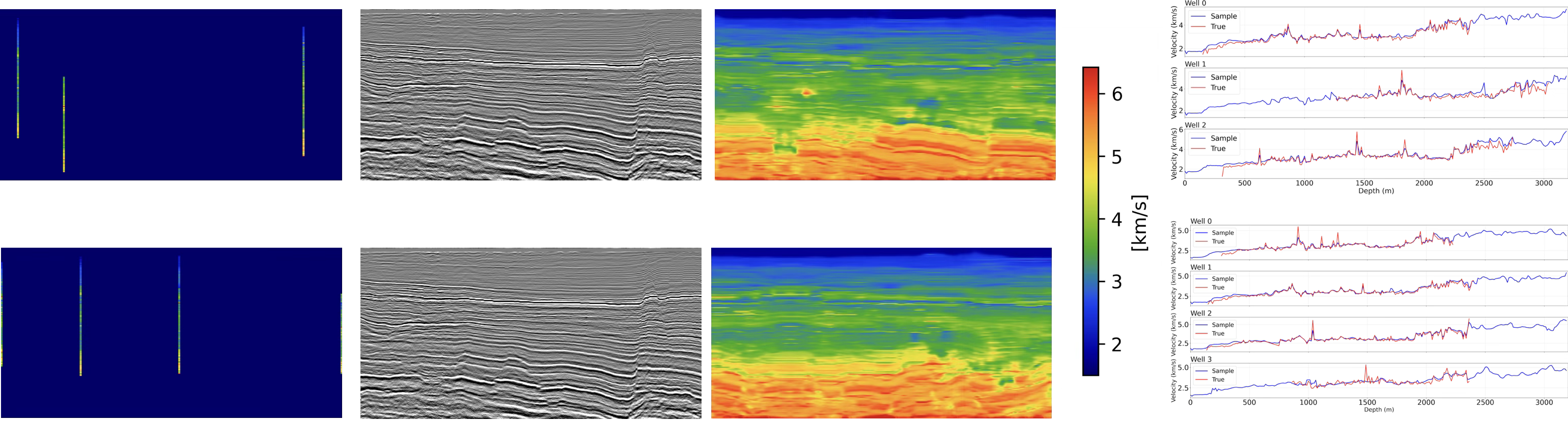
  • Velocity models (third and fourth columns) sampled from the proxy prior conditioned on real unseen seismic (second colum) and guided by unseen wells (first column) produced by generative model trained on NDR data (Erdinc et al., 2026).

  • Samples from the proxy prior will be used to train Yin et al. (2024a) via WISE.jl.

Closing the [FR-1] gap with SAGE

SAGESubsurface AI-driven Geostatistical Extraction of proxy posteriors (Erdinc et al., 2026) — distills National Data Repository information into a trainable prior, plugged into WISE [variational FWI; Yin et al. (2024b); Yin et al. (2024a)] via WISE.jl.

Closing

  • Differentiable programming is mature. Wave + flow + rock + ML inverted in one gradient — today, in open code (Louboutin, Yin, et al., 2023).
  • Software is no longer the bottleneck. Training data is.
  • SAGE + WISE + OpenSeisML build the missing [FR-1] layer on top of [FR-2]if industry and NDRs help unlock the data.
  • Need help currating training data from National Data Repositories around the world.

Thank you — let’s build the data layer in the open.

github.com/slimgroup · felix.herrmann@gatech.edu

Colophon

These slides were generated with the assistance of Claude Code (Anthropic).

Source, bibliography, and reproducible Quarto build at github.com/slimgroup.

© 2026 the authors. Licensed under Creative Commons Attribution 4.0 International (CC BY 4.0).

References

Bhar, I., Erdinc, H. T., Souza, T., Jones, C., & Herrmann, F. J. (2026). OpenSeisML: Open large-scale real seismic and well-log dataset for generative AI. IMAGE 2026 expanded abstract (submitted). https://slim.gatech.edu/Publications/Public/Submitted/2026/
Donoho, D. (2024). Data science at the singularity. Harvard Data Science Review, 6(1). https://doi.org/10.1162/99608f92.b91339ef
Erdinc, H. T., Bhar, I., Orozco, R., Louboutin, M., & Herrmann, F. J. (2026). SAGE: Subsurface AI-driven Geostatistical Extraction of proxy posteriors. SLIM, Georgia Institute of Technology. https://slim.gatech.edu/content/sage-subsurface-ai-driven-geostatistical-extraction-proxy-posterior
Grady II, T. J., Khan, R., Louboutin, M., Yin, Z., Witte, P. A., Chandra, R., Hewett, R. J., & Herrmann, F. J. (2023). Model-parallel Fourier neural operators as learned surrogates for large-scale parametric PDEs. Computers & Geosciences, 178, 105402. https://doi.org/10.1016/j.cageo.2023.105402
Grady, T. J., & Louboutin, M. (2022). Slimgroup/dfno [Computer software]. Zenodo. https://doi.org/10.5281/zenodo.6981516
Innes, M. (2018). Don’t unroll adjoint: Differentiating SSA-form programs. arXiv Preprint arXiv:1810.07951. https://doi.org/10.48550/arXiv.1810.07951
Innes, M., Edelman, A., Fischer, K., Rackauckas, C., Saba, E., Shah, V. B., & Tebbutt, W. (2019). A differentiable programming system to bridge machine learning and scientific computing. arXiv Preprint arXiv:1907.07587. https://doi.org/10.48550/arXiv.1907.07587
Louboutin, M., Lange, M., Luporini, F., Kukreja, N., Witte, P. A., Herrmann, F. J., Velesko, P., & Gorman, G. J. (2019). Devito (v3.1.0): An embedded domain-specific language for finite differences and geophysical exploration. Geoscientific Model Development, 12(3), 1165–1187. https://doi.org/10.5194/gmd-12-1165-2019
Louboutin, M., Witte, P. A., Yin, Z., Modzelewski, H., Kerim, da Costa, C., & Nogueira, P. (2023). Slimgroup/JUDI.jl [Computer software]. Zenodo. https://doi.org/10.5281/zenodo.7785440
Louboutin, M., Yin, Z., Orozco, R., Grady II, T. J., Siahkoohi, A., Rizzuti, G., Witte, P. A., Møyner, O., Gorman, G. J., & Herrmann, F. J. (2023). Learned multiphysics inversion with differentiable programming and machine learning. The Leading Edge, 42(7), 474–486. https://doi.org/10.1190/tle42070474.1
Luporini, F., Louboutin, M., Lange, M., Kukreja, N., Witte, P. A., Hückelheim, J., Yount, C., Kelly, P. H. J., Herrmann, F. J., & Gorman, G. J. (2020). Architecture and performance of devito, a system for automated stencil computation. ACM Transactions on Mathematical Software, 46(1), 1–28. https://doi.org/10.1145/3374916
Møyner, O., & Bruer, G. (2023). Sintefmath/JutulDarcy.jl [Computer software]. Zenodo. https://doi.org/10.5281/zenodo.7775738
Møyner, O., Johnsrud, M., Nilsen, H. M., Raynaud, X., Lye, K. O., & Yin, Z. (2023). Sintefmath/jutul.jl [Computer software]. Zenodo. https://doi.org/10.5281/zenodo.7775759
Orozco, R., Witte, P. A., Louboutin, M., Siahkoohi, A., Rizzuti, G., Peters, B., & Herrmann, F. J. (2024). InvertibleNetworks.jl: A Julia package for scalable normalizing flows. Journal of Open Source Software, 9(99), 6554. https://doi.org/10.21105/joss.06554
White, F. C., Abbott, M., Zgubic, M., Schaub, S., Robinson, N., Revels, J., Arakaki, T., Bradbury, J., Schmitz, N., Heim, N., Karrasch, D., Lucibello, C., Garcia, P. V., Ge, H., Robson, A., Christie, O., Ma, Y., Pakman, A., Doris, A., & Heeren, F. (2023). JuliaDiff/ChainRules.jl [Computer software]. Zenodo. https://doi.org/10.5281/zenodo.7628788
Witte, P. A., Louboutin, M., Kukreja, N., Luporini, F., Lange, M., Gorman, G. J., & Herrmann, F. J. (2019). A large-scale framework for symbolic implementations of seismic inversion algorithms in Julia. Geophysics, 84(3), F57–F71. https://doi.org/10.1190/geo2018-0174.1
Witte, P. A., Louboutin, M., Orozco, R., Rizzuti, G., Siahkoohi, A., Herrmann, F. J., Peters, B., Haraldsson, P., & Yin, Z. (2023). Slimgroup/InvertibleNetworks.jl: A julia package for scalable normalizing flows [Computer software]. Zenodo. https://doi.org/10.5281/zenodo.7693048
Yin, Z., & Louboutin, M. (2023). Slimgroup/JutulDarcyRules.jl [Computer software]. Zenodo. https://doi.org/10.5281/zenodo.7762154
Yin, Z., Orozco, R., Louboutin, M., & Herrmann, F. J. (2023). Solving multiphysics-based inverse problems with learned surrogates and constraints (No. 14; Vol. 10). https://doi.org/10.1186/s40323-023-00252-0
Yin, Z., Orozco, R., Louboutin, M., & Herrmann, F. J. (2024a). Slimgroup/WISE.jl [Computer software]. Zenodo. https://github.com/slimgroup/WISE.jl
Yin, Z., Orozco, R., Louboutin, M., & Herrmann, F. J. (2024b). WISE: Full-waveform variational inference via subsurface extensions. Geophysics, 89(4), A23–A28. https://doi.org/10.1190/geo2023-0744.1